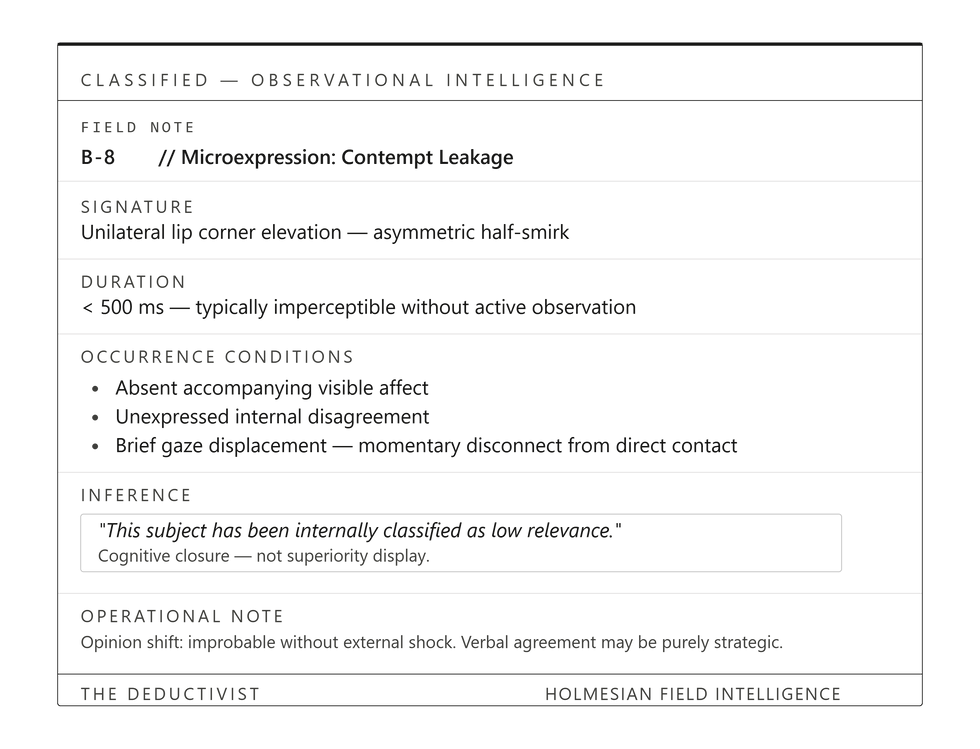
FIELD NOTE B-8 // Contempt Leakage
- Matthew Blackwood

- Jun 15
- 3 min read
The moment someone silently decides you are no longer worth the effort.

There is a peculiar moment in conversation.
The other person continues nodding.
They remain polite.
Their words continue cooperating.
And then, for a fraction of a second, one corner of the mouth rises.
Not a smile.
A verdict.
Somewhere beneath the surface, the evaluation process has already concluded.
The internal report is brief:
This information is not valuable.
This person is not worth additional cognitive investment.
The conversation continues.
The judgment often does not.
Continuing to argue with logic at this point can become remarkably inefficient. The individual may still be speaking, but the decision-making process has already left the room.
If you wish to alter the outcome, additional arguments rarely help.
Something in the situation itself must change.
🎭◦◦◦📃◦◦◦🎭
Signal Structure
Contempt typically appears as a unilateral elevation of the mouth corner.
One side rises.
The other refuses participation.
This asymmetry matters.
When both corners rise, we usually enter the territory of positivity — genuine or otherwise.
Popular culture refers to this configuration as a smile.
Contempt appears to have negotiated a smaller budget.
Only a single corner of the face was deemed necessary.
The remaining musculature appreciated the reduced workload.
The movement usually lasts less than half a second.
Conveniently brief.
Almost as if human psychology developed a personal grievance against observational accuracy.
🎭◦◦◦📃◦◦◦🎭
Context
The expression most commonly emerges during social evaluation.
Status comparisons.
Silent disagreement.
Private judgment.
Unspoken conclusions.
Human civilization has invested heavily in internal commentary.
For reasons that remain deeply inconvenient, access to this commentary was never distributed publicly.
Fortunately, fragments occasionally leak through the architecture.
Contempt is one of them.
🎭◦◦◦📃◦◦◦🎭
Observation Layer
Under ordinary circumstances, contempt leakage appears:
A) Without accompanying joy.
The mouth begins behaving as if amusement exists.
The eyes disagree.
Coordination was apparently unavailable.
B) During disagreement that remains unspoken.
The individual chooses not to verbalize the objection.
The face briefly volunteers the information anyway.
A recurring administrative failure.
C) During temporary disengagement from direct eye contact.
Attention shifts inward.
Self-monitoring decreases.
The carefully maintained social mask suffers a brief systems outage.
Reality becomes visible.
🎭◦◦◦📃◦◦◦🎭
Inference
Contempt does not always indicate superiority.
This is a common mistake.
More often, it signals the completion of an internal classification process.
The individual has already assigned a value to the person, idea, or situation.
The classification may be correct.
It may be catastrophically wrong.
The important detail is that the evaluation has already occurred.
The signal is not:
“I am superior.”
The signal is closer to:
“Assessment complete.”
🎭◦◦◦📃◦◦◦🎭
Operational Note
Predicting specific behavior from a single expression remains unreliable.
Predicting resistance becomes considerably easier.
The appearance of contempt frequently suggests:
opinion change is unlikely without a meaningful external event
verbal agreement may be strategic rather than genuine
the conversation is no longer functioning as an exchange
persuasion now requires disruption, not repetition
Many people continue presenting evidence after contempt appears.
An admirable display of optimism.
Rarely an effective one.
🜂 ——— 📃 ——— 🜂
🔎 HOLMES NOTE
Contempt is rarely concealed successfully.
Most emotions seek expression.
Contempt seeks exemption.
The individual displaying it has often ceased evaluating the other party as an equal participant and has already rendered a private verdict.
For this reason, a fleeting unilateral smile is seldom the beginning of a judgment.
It is usually evidence that the judgment has already been made.
The expression itself is brief.
The conclusion behind it is not.
🜂 ——— 📃 ——— 🜂
Most people look for disagreement in words.
Contempt appears earlier.
The verdict is often written on the face long before it is spoken aloud.
— Blackwood. Matthew Blackwood.


Comments