FIELD NOTE B-8 // When Neutral Isn’t Neutral
- Matthew Blackwood

- Jun 23
- 4 min read
The Sherlock Holmes Method for Detecting Emotional Suppression
Or: a brief administrative conflict between emotion and the department responsible for appearances.

Fear is a remarkable instrument.
It influences negotiations.
Markets.
Elections.
Occasionally the selection of pastries.
This is not entirely reassuring.
Most people imagine fear as something obvious.
Shaking hands.
A trembling voice.
Visible discomfort.
Reality rarely cooperates.
In environments where appearing calm is advantageous, fear often changes strategy.
It stops announcing itself.
It starts negotiating.
The result is frequently not fear.
The result is neutrality.
Or something attempting to resemble it.
🎭◦◦◦📃◦◦◦🎭
OBSERVATION LAYER
Consider a person in a job interview.
Or a waiting room.
Or any environment where consequences are being quietly calculated.
The face appears neutral.
Nothing dramatic occurs.
Yet several details emerge:
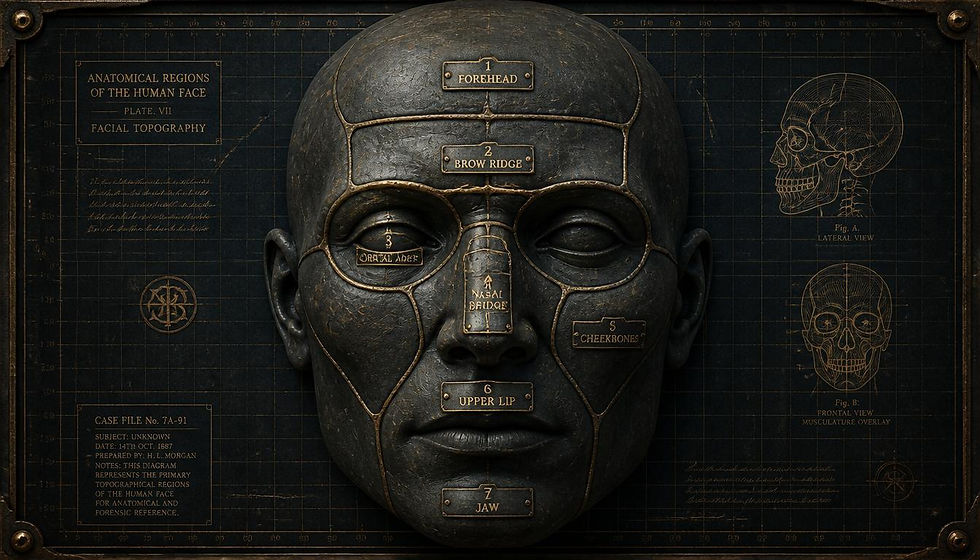
A slight elevation of the inner eyebrows.
Reduced movement around the mouth.
Brief expressions that appear and disappear rapidly.
An overall reduction in facial variability.
Nothing here proves fear.
Nothing here even proves emotion.
The evidence supports only one conclusion:
The face appears unusually controlled.
That is where the investigation begins.
🎭◦◦◦📃◦◦◦🎭
SIGNAL STRUCTURE
The useful signal is not any single feature.
It is the cluster.
Signal 1
Slight elevation of the inner eyebrows.
Subtle.
Brief.
Easy to miss.
Particularly when attention remains focused on words.
Signal 2
Reduced movement around the mouth.
The mouth becomes less expressive.
Less spontaneous.
Almost economical.
Signal 3
General facial restraint.
The face appears neutral.
Yet the neutrality feels maintained rather than natural.
This distinction matters.
Natural neutrality requires little effort.
Maintained neutrality often leaves traces.
The signal is not fear.
The signal is effort.
CONTEXT
Context determines whether the signal deserves attention.
Strong situations often produce emotional regulation.
Examples include:
Job interviews
Clinical assessments
Formal evaluations
Interactions with authority figures
High-stakes conversations
In such environments people frequently attempt to regulate visible emotion.
The behaviour is rational.
The consequences feel important.
The nervous system has opinions.
🎭◦◦◦📃◦◦◦🎭
COMPETING EXPLANATIONS
Several explanations remain possible.
All deserve temporary survival.
Hypothesis A
Fear.
The individual perceives potential loss.
Status.
Opportunity.
Approval.
The system responds accordingly.
Hypothesis B
Stress.
Not fear specifically.
Simply elevated pressure.
Hypothesis C
Professional neutrality.
The person is intentionally suppressing visible reactions.
No distress required.
Only discipline.
Hypothesis D
Concentration.
Attention has been allocated internally.
Facial expressiveness decreases as cognitive load increases.
Hypothesis E
Fatigue.
Reduced expressiveness can emerge from depleted resources rather than emotional regulation.
At present, all explanations remain employed.
Reality has not selected a winner.

ELIMINATION
Additional observations arrive.
The difficult topic appears.
The face tightens slightly.
The mouth becomes less mobile.
The eyebrow movement returns.
Interesting.
The pattern repeats when uncertainty enters the conversation.
Now some explanations gain strength.
Others weaken.
Notice what has not happened.
We have not proven fear.
We have not achieved certainty.
We have simply increased the probability that emotional regulation is occurring.
The alternatives begin requesting additional evidence.
🎭◦◦◦📃◦◦◦🎭
INFERENCE (PROVISIONAL)
The raised inner eyebrows do not automatically indicate fear.
Neither does reduced movement around the mouth.
The useful observation is something else.
The face appears neutral.
Yet the neutrality seems maintained rather than natural.
Moments occur where emotion begins moving in one direction and is immediately corrected.
The observer should resist the temptation to label the emotion too quickly.
Fear remains possible.
So do several alternatives.
The signal is not fear.
The signal is effort.
🎭◦◦◦📃◦◦◦🎭
OPERATIONAL NOTE
When this pattern appears, continue gathering evidence.
Do not immediately interpret.
Instead:
Observe whether the signal increases under pressure.
Observe whether it disappears when pressure decreases.
Observe whether it appears around specific topics.
Observe whether it appears around specific individuals.
Patterns deserve attention.
Single moments deserve caution.
🜂 ——— 📃 ——— 🜂
🔎 HOLMES NOTE
Emotion is difficult to observe.
The attempt to conceal emotion is often easier.
Most observers search for feelings.
The better question is:
What effort is being expended to prevent those feelings from becoming visible?
🜂 ——— 📃 ——— 🜂
🩺 WATSON NOTE
Observers frequently attempt to identify emotions immediately.
Reality rarely provides sufficient evidence.
A neutral face may conceal fear.
A neutral face may conceal concentration.
A neutral face may conceal fatigue.
A neutral face may conceal nothing at all.
The objective is not faster certainty.
The objective is remaining uncertain longer than everyone else.
That discipline often marks the boundary between observation and imagination.
🜂 ——— 📃 ——— 🜂
Captain. Your assignment, should you choose to accept it.
For the next 24 hours, treat every neutral face as a hypothesis rather than a conclusion.
Observe environments where appearing calm is advantageous.
Waiting rooms.
Job interviews.
Classrooms before examinations.
Formal meetings.
Public transport.
Look for:
Slight elevation of the inner eyebrows.
Reduced movement around the mouth.
Brief expressions that appear before composure returns.
Signs that neutrality is being maintained rather than simply existing.
For each observation record:
What you saw.
Alternative explanations.
Additional evidence required.
Do not identify emotions.
Identify uncertainty.
The emotions can wait.
══════════ ⚜ ══════════
The game is afoot.
Follow the evidence wherever it leads.
For truth.
For civilization.
For properly labelled evidence bags.
══════════ ⚜ ══════════
— Blackwood. Matthew Blackwood.


Comments