The Architecture of a Smile
- Matthew Blackwood

- May 24
- 2 min read
Updated: Jun 15
Or, Why the Eyes Continue Ruining Perfectly Prepared Lies
Since childhood, society has trained us to smile on command.
An extraordinary investment, really.
Entire industries now exist to whiten teeth designed primarily for professional deception.
Modern civilization has apparently decided that dishonesty should at least appear hygienic.
Fortunately, the system continues leaking information despite these efforts.
Under ordinary circumstances, distinguishing a genuine smile from a social one is not especially difficult.
One emerges naturally.
The other arrives slightly too prepared.
◇ ——— ◇ ——— ◇
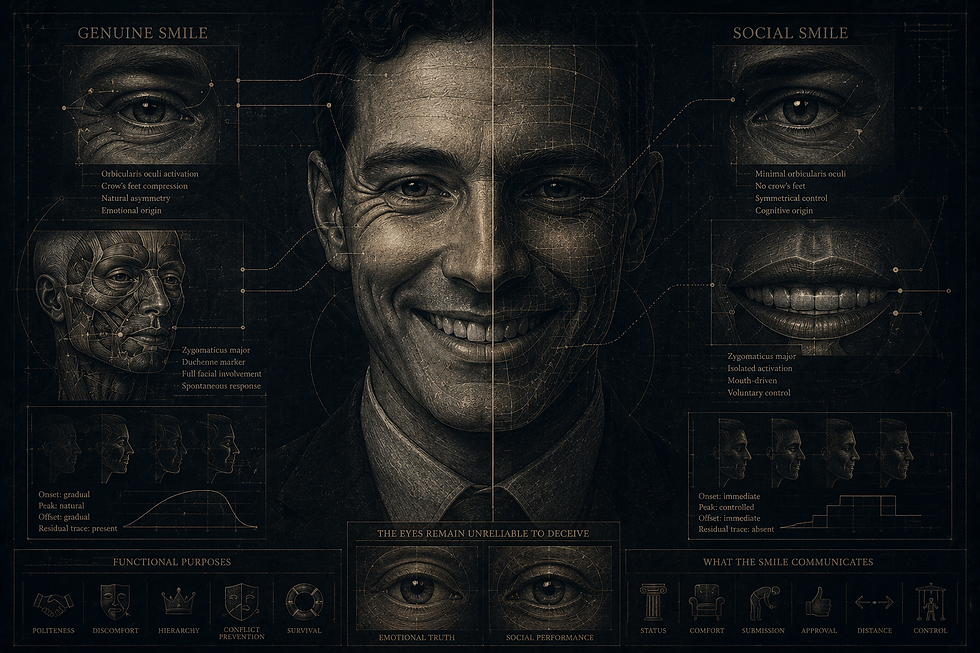
A genuine smile is rarely random.
It is a reaction.
The system responding before the conscious mind has time to reorganize the performance.
The movement begins subtly around the eyes. Small muscles activate automatically, creating compression, warmth, and slight asymmetry impossible to reproduce convincingly through deliberate effort alone.
The face participates as a unified structure.
A social smile behaves differently.
The mouth moves first. Efficiently. Politely. Sometimes beautifully.
The eyes remain operationally absent.
An impressive architectural façade supported by no internal infrastructure whatsoever.
Unfortunately for professional deceivers, the eyes were never designed for diplomacy.
They continue reporting emotional reality long after the mouth has begun negotiations.
◇ ——— ◇ ——— ◇
Timing matters.
Genuine smiles appear fluidly and disappear gradually, often leaving small residual traces behind. The system relaxes naturally.
False smiles tend to activate and deactivate with suspicious precision, as if controlled by an internal administrative department concerned primarily with social compliance.
Too fast.
Too symmetrical.
Too aware of being observed.
Recognition remains one of humanity’s favorite addictions.
🜂 ——— 📃 ——— 🜂
🔎 HOLMES NOTE
Genuine smiles usually arrive before the person remembers they are being watched.
🜂 ——— 📃 ——— 🜂
Context matters more.
People smile socially for perfectly rational reasons:
– politeness
– discomfort
– hierarchy management
– conflict prevention
– survival inside corporate environments
Not every false smile is malicious.
Some are simply exhausted.
Others are performing emotional labor for audiences they never asked to entertain.
The distinction, as usual, is structural.
🎭◦◦◦📃◦◦◦🎭
Most people think smiles communicate happiness.
More often, they communicate negotiation.
Status.
Comfort.
Submission.
Approval.
Distance.
Control.
The mouth says:
“I am smiling.”
The eyes quietly clarify:
“Under protest.”


Comments