Nothing to See Here
- Matthew Blackwood

- 3 days ago
- 8 min read
Except a Career, an Identity Crisis, and Four Very Uncooperative Books.
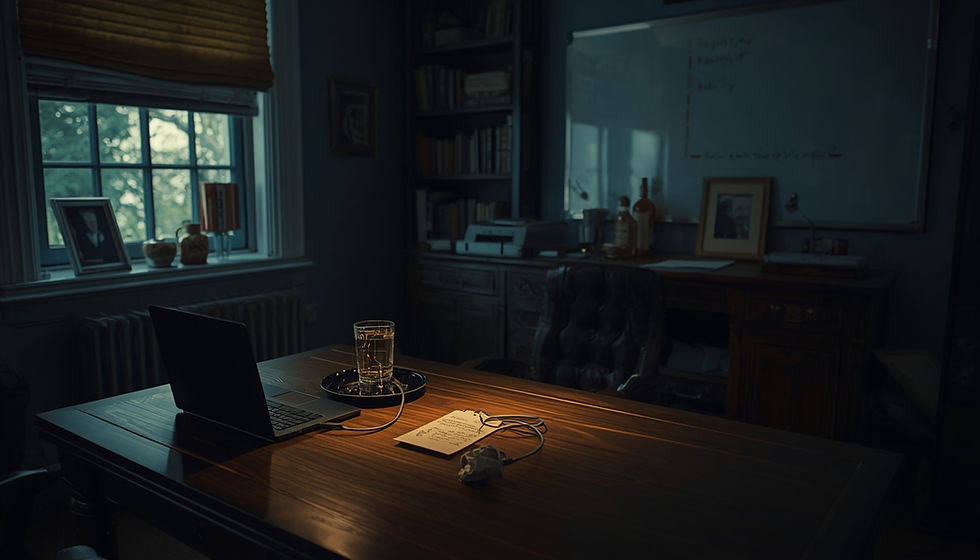
The room belongs to someone. They are not here. The objects, however, are. They have opinions about this arrangement.
◇ ——— ◇ ——— ◇
A home study, late afternoon. The blind is half-drawn — not for privacy, since the window faces a garden with no neighbors — but because someone lowered it at some point and did not raise it again. The light is yellowish. The dust is not excessive, but it is present, and it is informative.
The desk is large, dark wood, and mostly clear. On the left side: a laptop, open, screen dark. The charging cable is plugged into the machine; the other end lies loose on the desk. On the far right corner: a rectangle of slightly cleaner wood, approximately phone-sized, where something stood until recently and no longer does. The objects that remain have not been asked about this. They are pretending not to notice.
Two coffee mugs. The first is near the laptop — dry, with a dark residue ring at the bottom that has been there long enough to require soaking to remove. The second is on the windowsill, recently washed, placed upside down on a folded dish towel to dry. One of these mugs belongs here. The other belongs to a visitor who understood the assignment and left anyway.
A whiteboard on the wall to the left of the desk. One column, labeled WEEK in capitals, contains a neat list of seven items. Five are crossed off. The second column is blank — but not clean. Something was erased recently. The residue is still there, caught in the tray at the bottom.
A suit jacket hangs over the back of the chair. The fabric is good — not department store good, but made-to-measure good, or close to it. The top button is missing. The thread is still there, frayed at the ends. This is not new damage. It has been not new damage for some time.
A bookshelf covers the left wall. Left half: professional titles, spines facing out, alphabetized with mild inconsistency. Right half: fiction. Most spines face out. Four do not. They have been turned inward — deliberately, since the other books were not disturbed — so that their titles are not visible from the desk. They are still there. They simply refuse to be looked at.
In the corner of the desk: a framed photograph, facing forward. It has not been removed. It has, however, been moved — the rectangle of undisturbed dust around where it previously stood is two centimetres to the right of where it now sits. It was moved recently. It was not moved far. That distance is a decision.
On the shelf above the desk: a clean highball glass and a bottle of whisky, roughly two-thirds full. The glass has been used and washed. The bottle has been opened many times; the pour marks on the label suggest routine, not emergency. This is a meaningful distinction.
A notepad on the desk, to the right of the laptop. The top several pages have been torn off cleanly. The impression of the last written page is faintly visible in the paper beneath: a column of numbers, and the word *scenario* written twice, once underlined.
On the floor beside the desk, not quite inside the bin: a piece of paper, crumpled but not violently so. The visible edge shows a formal letterhead and, in the body of the letter, the word *regret.* The bin is close. The paper did not make it. These things happen.
By the window: two plants. A small succulent on the left, healthy — compact, well-managed, correctly watered. On the right, a larger plant, recently and generously watered; the soil is still dark, and the lower leaves are yellowing at the edges. Someone watered it with good intentions and imprecise knowledge. The succulent declined to comment.
Running shoes by the door, soles facing up where they were kicked off. The treads are worn — these are used shoes. The wear pattern is uneven, heavier on the outer edge of each sole.
◇ ——— ◇ ——— ◇
Captain. Your assignment, should you choose to accept it.
Determine what professional event has recently occurred and has not yet been resolved — and identify what the four books turned spine-inward tell you about the person that the letter on the floor will not.
The game is afoot.
Follow the evidence wherever it leads.
For Truth. For Civilization. For Properly Labelled Evidence Bags.
· · · ◈ · · ·
If you're reading this without having written anything down — you already know what that means.
SOLUTION
The professional event
A formal rejection arrived. The word regret in a letterhead document is not a medical result, not a termination, not a legal notice — it is the specific vocabulary of institutions, investors, and commissioning bodies declining a proposal. The paper was crumpled but not destroyed. That is controlled disappointment, not rage. And it was not thrown into the bin — only near it. The person has not yet decided what to do with the no. The bin is close enough to suggest they are considering it. Far enough to suggest they haven't.
The word scenario written twice on the torn notepad — once underlined — alongside a column of numbers points to a costed proposal: budget, timeline, or both. The pages were removed and taken, which means the work itself left the room. What remained was the impression of it, faint in the paper underneath. The erased second column on the whiteboard was almost certainly a post-approval plan — what to do if the answer was yes. It was erased after the answer was no.
This is a person who prepared thoroughly, presented formally, and received a rejection they had considered possible but not fully accepted as likely.
The clean rectangle on the desk
Too large for a phone, too small for a monitor. A tablet, or a secondary device, removed from the desk. Either taken to the presentation and not brought back — or removed afterward, because objects that served a project that failed are temporarily unwelcome. The charging cable lies loose because the device it belonged to is not here. The cable has not been put away because putting it away would be a form of acceptance.
The visitor
The second mug is the clearest evidence of another person in the file — and the most precisely read detail available. The occupant's mug is near the laptop, dry, with old residue. It has not been washed because washing it would require a level of domestic attention that is currently not being applied to anything. The second mug was washed, dried face-down on a folded towel, and left on the windowsill. Someone came, drank something, cleaned up after themselves, and left.
The larger plant confirms the visitor's proximity and its limits simultaneously. The succulent is fine — succulents survive inattention by design, which is presumably why this person owns one. The larger plant was watered generously, with soil still dark and lower leaves beginning to yellow from overwatering. The visitor knew the plant needed water. They did not know how much. This is someone close enough to act, not close enough to know the specifics. A friend, most likely. A sibling is also possible. A partner would have known about the plant.
The photograph
It was not removed. It was not turned face-down. It was moved two centimetres. That is the most precise gesture in the entire room — and the most telling. Two centimetres is not distancing. It is handling. The person picked it up, looked at it, and set it down in a slightly different place. This has probably happened more than once; the dust displacement is consistent with repeated small adjustments rather than a single deliberate repositioning. The photograph is not a problem. It is a reference point. The family, or whoever is in it, is not the source of the difficulty — they are the reason the difficulty matters.
The four books
This is where the letter and the books diverge, and the divergence is the answer to the second part of the assignment.
The letter says what happened: the project was rejected. That is information about the world.
The four books say something about the person that no external document can: these are titles whose spines cannot be faced during work, but which cannot be removed from the shelf. Turning them inward is the physical midpoint between keeping and discarding — an enacted ambivalence, carried out carefully enough not to disturb the books around them. They are almost certainly titles connected to the identity the person is currently uncertain about: books about craft, creative ambition, success in a specific field, or the specific genre or discipline the rejected project inhabited.
If the person were certain they would try again, the books would be facing out. If they had decided to stop, the books would be gone. They are neither. They stand on the shelf, turned away from the desk, waiting to be looked at again when the person has decided what they are.
The letter will eventually go in the bin. The books will eventually be turned back around. The question the room does not answer is which comes first — the decision to discard the rejection, or the decision to reclaim the identity.
The two-centimetre photograph suggests the person is not without resources. The running shoes by the door — worn treads, used regularly, weighted on the outer edge in the way of someone who has been running this route for years — confirm that the body's routine survived the mind's disruption. This is not someone in collapse. This is someone in suspension.
The button has been missing from the jacket for a long time. That detail predates the letter entirely. It belongs to a different chapter — one where small maintenance tasks are deferred not because of crisis, but because the person's attention has always lived elsewhere. The project is not a recent obsession. It is a long-standing one. The room has been organized around it for longer than the letter has existed.
◇ ——— ◇ ——— ◇
HOW THIS WAS SOLVED
The first constraint: a room with no person must still yield a person. That means ignoring nothing and explaining nothing from a single detail. Individual objects have explanations. Patterns have mechanisms.
The entry point was the letter on the floor. The word *regret* in a formal letterhead is a specific linguistic register — institutional, not personal. That narrows the professional context immediately. Combined with *scenario* written twice on a notepad and a column of figures, it points to a proposal with financial dimensions, formally submitted and formally declined.
From there, the erased whiteboard column became legible: a post-approval plan, removed after approval did not arrive. The torn notepad pages were taken, not discarded — the work left the room, which means the person did not give up on it in the room. They removed it from the environment, which is different.
The clean rectangle on the desk was held in suspension until the charging cable confirmed it: a device is missing, and the cable was not put away. That is not absent-mindedness in a room this organized. That is a deferred decision.
The visitor was constructed from two details cross-referenced: the second mug, washed and face-down on a folded towel, and the overwatered plant. Each detail is explainable independently. Together they are not — the same person who cared enough to wash the mug cared enough to water the plant and knew the plant needed it and did not know the correct amount. That is a specific combination. It defines the relationship precisely.
The photograph was read last, after the emotional temperature of the room was established. Two centimetres is not a significant distance. It is a significant number of times. The photograph has been handled repeatedly in a small radius. That is not grief. That is orientation.
The four books were the final detail — and the most deliberately constructed misdirection in the room. The obvious reading is concealment: the person is hiding something about their taste or their past. The correct reading requires noticing what the books were not: they were not removed, not stacked face-down, not placed elsewhere. They were turned. That is a position that preserves the option to turn them back. Concealment removes the object from view. Ambivalence turns it away while keeping it within reach.
The letter answers what happened. The books answer who the person was before it happened — and whether they intend to remain that person. On the available evidence: probably yes. The notebook is gone but the impression remains. The photograph has not moved far. The shoes are by the door.
The project failed. The person has not yet decided that they have.
— Blackwood. Matthew Blackwood.


Comments